Working with Discover process models and Import BPMN models
Introduction
This page describes the specific elements of a process graph created from a Discover process model or an Import BPMN model.
Process graphs created from a Discover model or an Import BPMN model use the same semantic. The process mining type used for your process app is selected when the app was created. Check out Switching the process mining type and Importing a BPMN model.
The process graph is a combination of the Discover model or Import BPMN model and your data. The event log for your process is aligned on top of the model, allowing you to see behavior such as exclusive choice, parallelism, and loops. Such behavior is indicated with so called gateways, which always come in pairs.
Node types used in a Discover or BPMN process model
| Node type | Example | Description |
|---|---|---|
| Exclusive choice |  | In an exclusive choice, either A or B happens. The topmost gateway is called the open gateway, which indicates where the choice behavior begins. The bottom-most gateway is called the close gateway, which indicates where the choice behavior ends. |
| Loop | 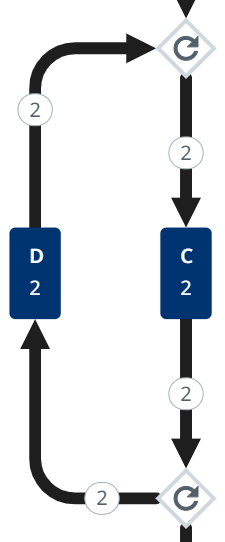 | In a loop, C is executed first after which D happens as part of the loop behavior. The topmost gateway is called the open gateway, which indicates where the loop behavior begins. The bottom-most gateway is called the close gateway, which indicates where the loop behavior ends. |
| Parallelism | 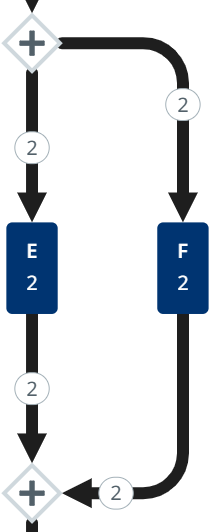 | In a parallelism, E and F happen in parallel. The topmost gateway is called the open gateway, which indicates where the parallel behavior begins. The bottom-most gateway is called the close gateway, which indicates where the parallel behavior ends. |
Metric computation
In a Discover process model or BPMN process model, some metrics are computed slightly different.
- Variants now take parallelism into account. For example, when there are two objects *<A, B, C>
- and *<A, C, B>
- where *B
- and *C
- happen in parallel. This will now result in a single variant.
- Timings now take parallelism into account. This means timing metrics are more accurate.
Filters
In a Discover process model or BPMN process model, filters mostly work as usual. However, Starts with, Ends with, Directly follows, Indirectly follows filters take gateways, and in particular parallelism, into account.
For example, if a process starts with parallel behavior that includes activities A and B, a Starts with A filter and Starts with B filter will both return true.